Remote GPU Workstations for Agent Development Teams
How to run secure, shared remote GPU workstations for agent engineers, with a hard look at access controls, scheduling, and the real hardware cost math.

Average GPU usage of 5% across enterprise Kubernetes clusters is not a measure of engineer productivity; it measures how long accelerators sit with idle streaming multiprocessors while their request slots remain claimed. For agent engineering teams, the figure is the argument for pooled remote workstations over per-seat silicon.
Agent development needs H100- or A100-class hardware for fine-tuning runs, evals, and local inference against production-weight models. The engineering question is how to share that silicon without leaking source code, model weights, or training data between the people writing the agents, and how to defend the hardware bill once the sharing works.
Usage Is a Distribution Problem
Cast AI's 2026 report gives numbers specific enough to act on. Across roughly 23,000 clusters, GPU usage averaged 5%, and provisioned capacity ran about twenty times observed demand because clusters are sized for peak and because GPU sharing is almost never configured.
Developer workstations amplify the pattern. A per-engineer DGX node spends most of the business day on a browser, a language server, and a few container builds, then burns through its VRAM ceiling for ninety minutes when a fine-tune or an eval kicks off. The use pattern is bursty and interactive. The provisioning is static and per-seat.
The move that works is decoupling the development environment from the accelerator. The engineer gets a thin remote workstation with code, editor, debugger, and container runtime, and acquires a GPU slice from a shared pool on demand, releasing it when the job finishes. The shape of the workload decides the fairness policy. The engineer does not.
The Confidentiality Surfaces No One Sizes For
A GPU scheduling discussion usually skips the attack surface. Three surfaces are worth enumerating before anyone draws architecture.
Source code is the first. The May 2026 breach at GitHub, in which a malicious Visual Studio Code extension reached a single engineer's device and resulted in the cloning of roughly 3,800 internal private repositories, is a reminder that the editor is the exploit path, not the GPU. Pulling the editor into a controlled remote workstation, where extensions, outbound DNS, and clipboard flow are policy-managed, is the rationale for secure remote development. The Sophos writeup walks the kill chain.
Model weights are the second. Fine-tuned checkpoints and retrieval indices are intellectual property that fits on a USB stick, and engineers reasonably want to run them against test prompts without a change-review ticket. The remote workstation is where lineage and residency controls earn their keep; weights produced on the pool should be addressable only through the registry that signed them.
Training and eval data are the third. The NIST draft SP 800-239 catalogues multi-tenant and insider risk on shared GPU fabric, silent data corruption, and firmware integrity weaknesses as first-class concerns for AI infrastructure. Shared accelerators without MIG partitioning, confidential-compute attestation, or namespace isolation fail that checklist on day one.
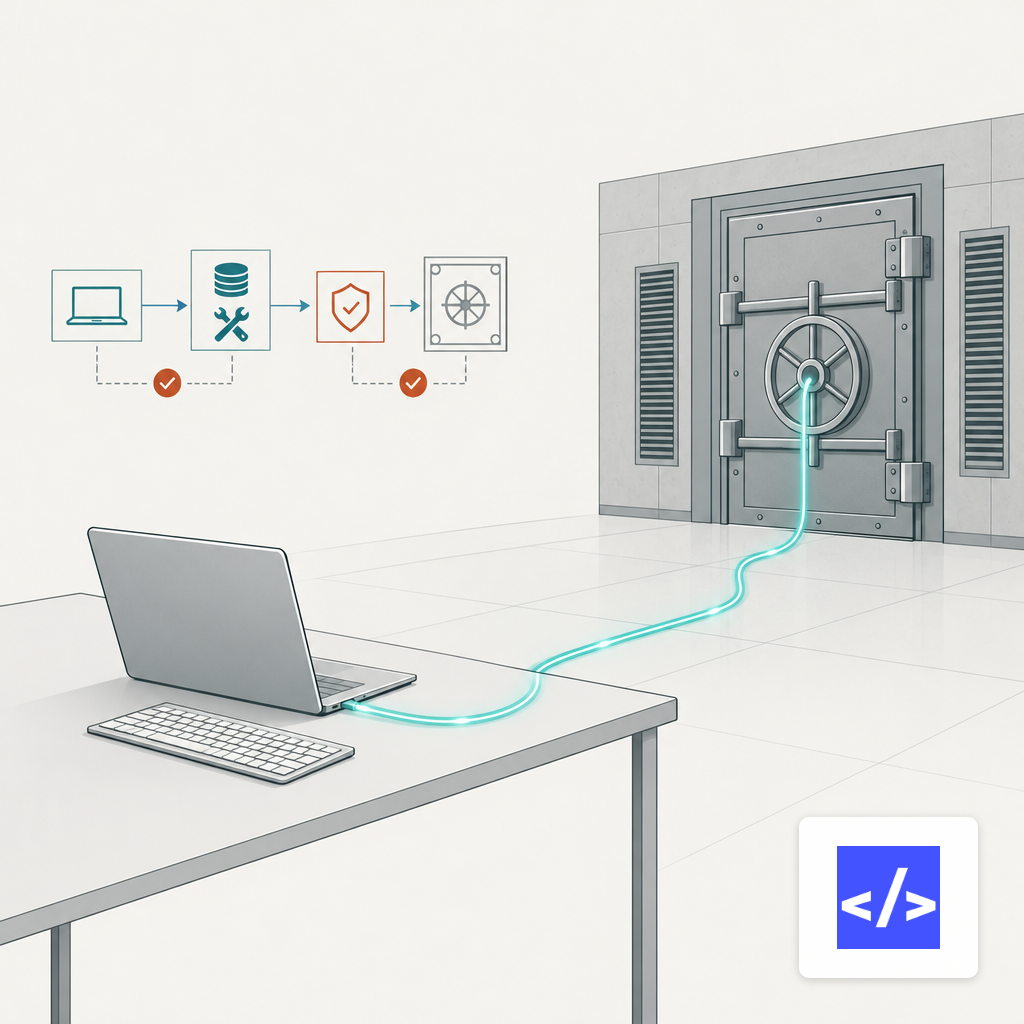
Fair-Share Scheduling That Protects the Critical Path
Fairness between engineers is where most pool designs quietly break. The default is first-come-first-served per request, which rewards whoever submits overnight batches and penalizes the engineer running a release-blocking eval during business hours.
Time-based fairshare schedulers assign each team a weighted share of GPU-hours over a rolling window, usually a week, and preempt lower-priority jobs when a team is under its share. That model works for training. It does not work for interactive debugging, which needs a warm GPU on a one-minute boundary and cannot tolerate preemption.
The practical shape is three tiers:
- Reserved: critical-path work (pending evals, canary deploys of a new agent version) behind the same approval gates used on production agent actions.
- Fair-share: routine fine-tuning and experimentation, time-sliced and preemptible, with MIG partitioning so a single H100 can expose up to seven isolated GPU instances rather than colocating workloads that will fight over cache.
- Opportunistic: a spot queue for anyone willing to pay with elasticity.
The tiers need an audit log, not a Slack channel. GPU resource sharing becomes defensible when every allocation decision is attributable to a policy and a reviewer.
Buy, Rent, or Keep a Workstation Under the Desk
NVIDIA began shipping DGX Spark on October 15, 2025 at $3,999: 128 GB of unified memory, up to a petaflop of AI performance, and local inference on models up to 200 billion parameters. For a team of twenty engineers, that is $80,000 of silicon plus the facilities, patching, and endpoint-management overhead that follows.
Hourly rental sets the ceiling. AWS on-demand pricing runs about $6.88 per H100 GPU-hour on the p5.48xlarge; Azure runs closer to $12.29; GPU marketplaces quote as low as $2.69 on spot capacity. An engineer running one H100 for four productive hours a workday lands between roughly $2,200 and $10,000 a month depending on provider.
The crossover is a usage calculation. A DGX Spark at $3,999 amortized over three years comes in around $0.15 per hour at full duty. At the 5% usage observed across enterprise clusters, the effective cost rises to roughly $3 per hour, worse than most hyperscalers for a device the engineer still has to keep patched.
The defensible pattern is a mixed fleet: a small on-prem reserve for engineers who need zero round-trip latency or who work on offline networks, and elastic cloud for everything else. The published spread between hyperscalers and GPU neoclouds justifies putting orchestration behind a provider abstraction instead of hard-coding one vendor.
Where the Cloud Dollar Is Going
Pricing is only half of the cost model. Industry survey data shows wasted public cloud spend rising in 2026 after years of decline, with generative AI workloads cited as the direct driver and GenAI adoption climbing year over year. The uncomfortable implication for engineering teams is that pooling GPUs without rightsizing them does not bring the bill down; it just moves waste from per-seat workstations to a shared ledger line nobody owns.
For teams whose runtime agents already sit inside a VPC or on-prem enclave, the workstation plane has to match the runtime plane. The piece on air-gapped, VPC, and SaaS placement covers the trade-offs, which rarely resolve on cost alone.
A Reference Stack Worth Standing Up
The architecture that holds up under audit has four planes.
Identity. SSO-backed, phishing-resistant, with device attestation as a precondition for workspace creation. No standing shell on the GPU host.
Workspace. A thin remote desktop or browser-rendered IDE running on cheap CPU, with the editor's extension list, egress policy, and clipboard controls managed centrally. The 2026 GitHub incident originated in an extension, not a credential; that is where the policy belongs.
Scheduler. Time-based fairshare for shared pools, MIG partitioning for the fair-share tier, approval gates for reserved slices. Weights produced in the pool land in a signed registry; nothing leaves the pool without lineage.
Data. Model weights, training sets, and eval corpora stay on volumes attached inside the pool's security boundary. Retrieval against production data goes through the same policy engine that governs agent runtime access. For regulated workloads, the pool runs in the same air-gapped environment as the production agents, so the developer plane does not become the regulatory weak link.
The point of the a16z breakdown is not that silicon is overbought. It is that the hidden two thirds of the stack (power, networking, cooling, land) is where sloppy architecture costs more than the GPU line item, and where capitalization mistakes become hard to unwind once a lease is signed.
The 5% Number, Reconsidered
Return to the opening figure. On a per-engineer workstation, that 5% is unrecoverable, because the hardware sits where it sits, drawing power at idle. On a pooled, policy-managed remote workstation, it becomes a design parameter: every point above baseline is cost recovered, every point below is bought with GPU-hours that could have run an eval.
The shift from static per-seat silicon to a pool with approval gates, fairshare scheduling, MIG isolation, and signed weight lineage is the same shift that moves agents themselves from pilot to production. The developer plane and the runtime plane converge on the same controls, and they should share the same architecture.
Throughout his extensive 15+ year journey as a digital marketer, Sam has left an indelible mark on both small businesses and Fortune 500 enterprises alike. His portfolio boasts collaborations with esteemed entities such as NASDAQ OMX, eBay, Duncan Hines, Drew Barrymore, Price Benowitz LLP, a prominent law firm based in Washington, DC, and the esteemed human rights organization Amnesty International. In his role as a technical SEO and digital marketing strategist, Sam takes the helm of all paid and organic operations teams, steering client SEO services, link building initiatives, and white label digital marketing partnerships to unparalleled success. An esteemed thought leader in the industry, Sam is a recurring speaker at the esteemed Search Marketing Expo conference series and has graced the TEDx stage with his insights. Today, he channels his expertise into direct collaboration with high-end clients spanning diverse verticals, where he meticulously crafts strategies to optimize on and off-site SEO ROI through the seamless integration of content marketing and link building.


Put an agent to work, the right way.
Start on Automatic and put the workflow you want to automate in front of engineers who have shipped agents in regulated environments.
Agentic AI, in your inbox.
Occasional, high-signal notes on building and operating AI agents — automation patterns, architecture, and governance. No spam.