What a Realistic Agent Payback Period Looks Like by Workflow Type
A sober breakdown of how long enterprise agent projects take to pay back, by workflow class, and which variables actually move the number.

Most agent proposals arrive at the CFO with a benefits column and no shape to the timing. The build cost is line-itemed. The savings are annualized. Payback shows up as a single confident number that assumes the pilot goes to production, adoption hits target, and nothing regresses. In practice, payback for an autonomous agent has a wide honest range, and the range depends far more on the workflow class than on the model or vendor.
The gap is real. Deloitte's 2025 survey of over 1,800 executives found most respondents reported satisfactory ROI on a typical AI use case within two to four years, well past the seven-to-twelve-month payback expected of ordinary technology investments, with only 6% reporting payback in under a year. Vendor-commissioned studies land shorter, but they measure winners. A defensible internal model has to price both worlds.
What follows is a set of realistic payback ranges for five common agent workflow classes, the variables that move the number, and the mechanics you can defend in front of finance. Ranges assume a mid-market to enterprise build in the $60k–$250k band, run inside your VPC, integrated with real systems of record.
Why Payback Ranges, Not Point Estimates
A single payback number is a forecast pretending to be a fact. The real number moves with transaction volume, exception rate, the cost of the person being displaced or augmented, and how much rework the agent creates upstream and downstream. Two identical builds against the same workflow can land four months apart because one team has clean master data and the other does not.
The honest framing is a range with the variables named. For each workflow class below, the low end assumes clean inputs, one owning team, and an existing manual baseline expensive enough to make labor arithmetic obvious. The high end assumes messy inputs, split ownership, and a baseline that already runs on partial automation. If a proposal cannot articulate where in that range it sits and why, it is not ready for a green-light decision. Formalizing that argument is what a proper AI feasibility modeling exercise produces before build starts.
Document-Heavy Back Office (AP, Claims Intake, KYC)
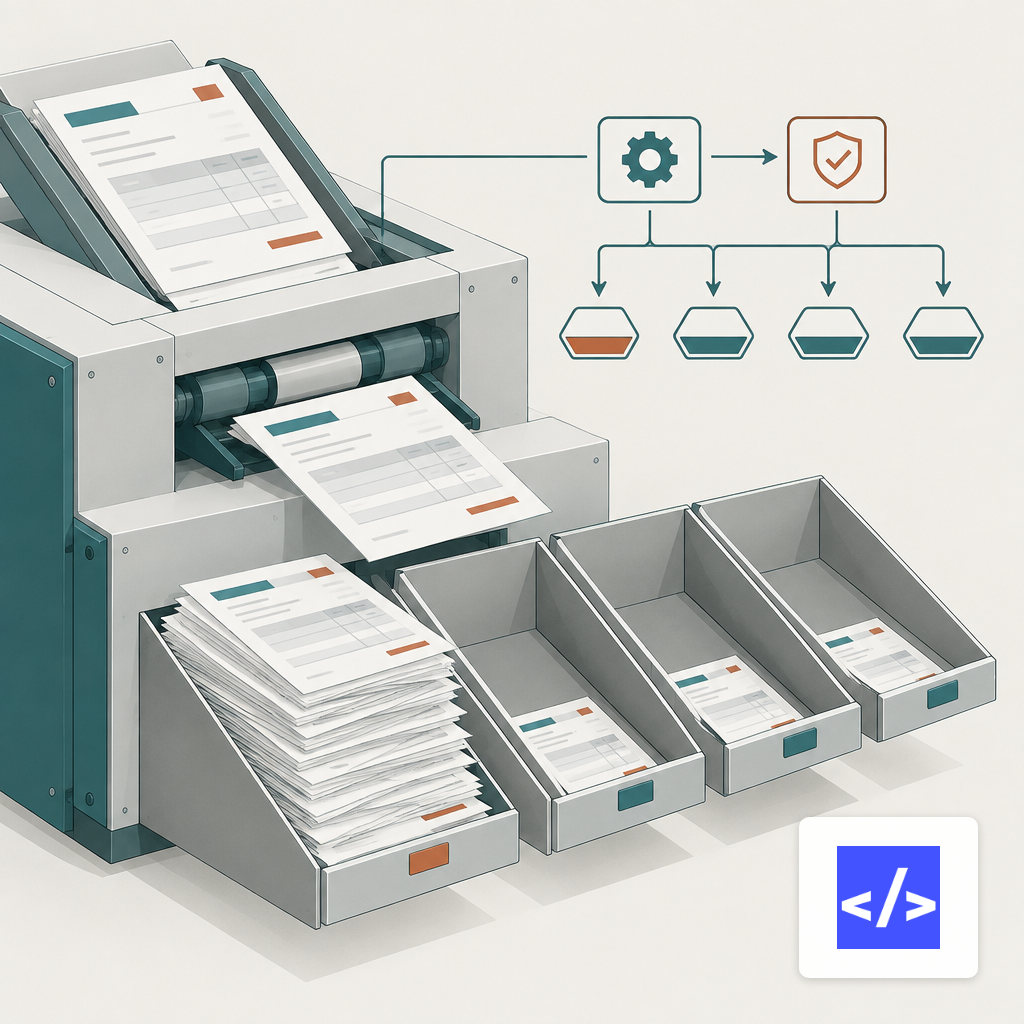
This is the shortest-payback class and the one most often overpromised. The work is high volume, structurally similar per transaction, and priced in fully loaded FTE hours. Agents here extract fields, match against a system of record, route exceptions, and post entries. The gains are labor hours and cycle time.
Realistic payback: 4 to 9 months. Vendor-friendly benchmarks are shorter. ScienceSoft reports an average payback of about six months for custom invoice automation, and Automation Anywhere puts typical RPA payback at six to nine months, with well-scoped high-volume processes landing in three to four. Agent builds add extraction quality and exception reasoning that classical RPA lacks, but also add token cost and evaluation overhead.
The variable that moves the number most is exception rate. If straight-through processing lands at 70%, the human queue is small and the labor math holds. If it lands at 40% because vendor formats vary or POs are inconsistent, the human team barely shrinks and payback drifts past a year. The other quiet killer is duplicate records, which is why deduplication at scale often has to be built before the agent, not around it.
Customer Service Deflection and Triage
Voice and messaging agents that handle tier-one contacts pay back on two things: contained volume and reduced handle time on what escalates. Both are measurable, both are gameable. Containment counted at the intent layer looks better than containment counted at CSAT or repeat-contact rate.
Realistic payback: 6 to 14 months for an enterprise build with proper telephony integration, guardrails, and QA. Vendor case studies land shorter — a 2025 Forrester study of PolyAI customers reported payback in under six months for a composite organization saving $10.3 million in agent labor over three years and cutting call abandonment by 50%. Gartner projects agentic AI will autonomously resolve 80% of common service issues by 2029 with a 30% reduction in operational costs, which is a directional signal rather than an underwriting number.
The variables: how much of your volume is genuinely repetitive, how brittle the CRM and knowledge base are, and whether you count avoided hires or actual headcount reductions. The second lands with finance; the first does not. Well before build, pressure-test which contact reasons actually qualify for full autonomy versus approval gates that add latency and human load.
Developer and Analyst Copilots
Copilots are the workflow class where payback math is most contested because the savings are per-seat time, not per-transaction throughput. The signal is real but noisy. A controlled GitHub experiment on an HTTP-server task showed developers with Copilot finished 55% faster than the control group, averaging 1 hour 11 minutes versus 2 hours 41 minutes, with a higher completion rate. That is a task-level result, not a payroll-level one.
Realistic payback: 9 to 18 months for enterprise AI copilots built on your codebase or analytical stack, with SSO, private inference, and evaluation infrastructure. The math moves with seat count, seat utilization, and the cost of the seat. A copilot for 400 senior engineers has very different arithmetic than one for 40 mid-level analysts.
The trap is treating time saved as money saved. Twenty percent faster ticket closure only converts to cash when it translates into fewer contractors, faster revenue cycles, or a project that ships in Q2 instead of Q3. Force the business case to name which of those it is.
Cross-System Orchestration (Onboarding, Order-to-Cash, Provisioning)
These are the workflows where agents earn their premium over classical automation, because the value is stitching together CRM, ERP, ticketing, and identity systems that have never spoken cleanly. They are also the ones where payback stretches longest, because integration is the cost, not the model.
Realistic payback: 10 to 20 months. The build absorbs discovery, API work, idempotency design, and a nontrivial amount of process redesign. Skipping the redesign is the classic failure mode, which is why bad processes make terrible bots holds regardless of how capable the underlying model is. IBM's CEO Study, cited by Corporate Finance Institute, found only 25% of AI initiatives deliver expected ROI and only 16% have scaled enterprise-wide. Orchestration projects are overrepresented in that shortfall.
What moves the number: how many systems, whether there is a workable event bus, and whether the agent has to operate against legacy screens instead of APIs. Cross-system agents also benefit disproportionately from a real AI agent architecture engagement upstream of the build, because the wrong topology is expensive to unwind after month three.
Regulated Decisioning (Underwriting, Adjudication, Compliance Review)
Agents that make or recommend consequential decisions in regulated domains have the longest payback of the five classes and the widest range. Value per decision is high, but so are the review, audit, and model-risk requirements around it. Payback here is not gated by build cost; it is gated by governance readiness.
Realistic payback: 12 to 24 months, and the range widens if the model risk function is new to LLM-based systems. Deloitte's finding that most enterprises see satisfactory returns in the two-to-four-year window is heavily weighted by projects that live in this class. The counterexamples exist. A Forrester TEI on FloQast reported 275% ROI and payback under six months for accounting close automation, and a Forrester TEI on Writer reported payback under six months with $3.61 million in three-year risk-adjusted costs. Both are narrower than full underwriting agents and shift most residual judgment back to the human.
The variables: how much of the decision the agent actually owns versus recommends, how many approval tiers sit above it, and whether your audit trail can survive a regulator. This is where the difference between which actions actually need human approval stops being a design question and becomes the entire payback question.
What the Ranges Have in Common
| Workflow class | Volume | Exception rate | Integration maturity | Governance load |
|---|---|---|---|---|
| Document back office | High impact | High impact | Medium | Low |
| Service deflection | High impact | High impact | Medium | Medium |
| Dev/analyst copilots | Medium | Low | Low | Low |
| Cross-system orchestration | Medium | Medium | High impact | Medium |
| Regulated decisioning | Low | Medium | Medium | High impact |
Four variables show up in every one of the five classes and dominate almost every other factor. Volume, because agents amortize; a low-volume workflow rarely pays back regardless of quality. Baseline labor cost, because you cannot save what you were not spending. Exception rate, because the human queue is where projected savings quietly leak. And integration maturity, because a clean API cuts build cost roughly in half compared to screen scraping against a legacy system.
Two more variables sit underneath the range but shape whether the number holds after month twelve: how honestly the team scoped straight-through processing, and whether the operating model can run the agent after handoff. Neither shows up in the build quote. Both show up in the twenty-fourth-month P&L.
Deciding Whether to Green-Light
A defensible go decision does three things the CFO can check. It names the workflow class and cites a payback range that matches the class, not the vendor deck. It identifies the two or three variables that move the range and states where this specific workflow sits on each. And it structures the build so the payback assumption is testable early, usually by delivering value on a narrow slice in the first eight to twelve weeks rather than a full workflow in month six.
Payback is not the only metric worth tracking, and short payback is not always the right answer. A regulated decisioning agent with an eighteen-month payback and a durable audit trail is often the correct investment over a service deflection agent with a six-month payback and a containment metric that erodes under scrutiny. What matters is that the number in the proposal is the number a competent skeptic would defend, and that the structure of the build lets you kill it fast if the assumptions do not survive contact with production. That is what makes an automation ROI model useful rather than decorative.
Eric Lamanna is a Digital Sales Manager with a strong passion for software and website development, AI, automation, and cybersecurity. With a background in multimedia design and years of hands-on experience in tech-driven sales, Eric thrives at the intersection of innovation and strategy—helping businesses grow through smart, scalable solutions. He specializes in streamlining workflows, improving digital security, and guiding clients through the fast-changing landscape of technology. Known for building strong, lasting relationships, Eric is committed to delivering results that make a meaningful difference. He holds a degree in multimedia design from Olympic College and lives in Denver, Colorado, with his wife and children.


Put an agent to work, the right way.
Start on Automatic and put the workflow you want to automate in front of engineers who have shipped agents in regulated environments.
Agentic AI, in your inbox.
Occasional, high-signal notes on building and operating AI agents — automation patterns, architecture, and governance. No spam.