How to Rip Out a UiPath Estate and Replace It With Agents
A sober migration plan for enterprises moving from UiPath RPA to agentic AI, with sequencing, licensing math, parallel-run rules, and the traps that burn budgets.

Most buyers considering a UiPath replacement did not arrive at the decision from a demo. They arrived from a renewal quote, a brittle quarter-end run, and a maintenance backlog that keeps growing even as the business value of each bot stays flat. The vendor's own pivot toward agents is now part of the pressure: UiPath launched its enterprise-grade Platform for Agentic Automation on April 30, 2025, with an orchestration layer called Maestro, which signals that the incumbent agrees the old model is ending.
That does not mean rip-and-replace is the right move. A disciplined migration treats the RPA estate as a portfolio: some bots retire, some get wrapped by agents, some stay exactly as they are for years. The question is not whether to replace UiPath with AI agents, but which bots to replace, in what order, and against what financial and operational cliff.
Start With a Portfolio Audit, Not a Platform Decision
Before any agent framework conversation, inventory every bot in Orchestrator and attach four numbers to each: annual license cost, developer-hours spent on maintenance in the last twelve months, exception rate, and the dollar value of what the bot actually produces. Most estates reveal the same shape. A small number of bots carry most of the value. A larger number carry most of the maintenance burden. And a surprising share do neither, having been built for a process that no longer exists in the form the bot assumes.
The brittleness pattern is well understood. Oracle documents that RPA bots are configured for specific workflows, and even minor changes like moving a button can break the automation and force ongoing maintenance. That is the mechanism behind the maintenance line in your inventory; it is not a people problem.
Score each bot on two axes: how much the underlying system changes, and how structured the inputs are. Bots sitting on stable mainframes with fixed-format inputs stay. Bots that touch frequently-updated SaaS UIs and process free-text, PDFs, or email are the first migration candidates. Our note on why bad processes make terrible bots applies here with extra force: a chaotic process wrapped in RPA will be an equally chaotic process wrapped in an agent, only now with a bigger blast radius.
Do the Licensing Cliff Math Before the Architecture
UiPath's financial position colors every renewal conversation. The company reported fiscal year 2025 revenue of US$1.43 billion with an operating loss of $163 million, which tells you the sales organization has specific incentives at your renewal, and that the published list prices have real room to move. Independent benchmarking puts unattended robot list price at $8,000 to $15,000 per robot per year and attended at $1,500 to $3,000 per user per year, with platform fees layered on top.
The cliff is this: license cost is linear in bots, but value is not. If 20 bots produce 80% of the value and the other 60 sit between $8K and $15K each in unattended fees, the retirement math is immediate. Model two numbers for every candidate bot:
- Fully loaded annual cost: license, orchestrator share, developer maintenance hours at loaded rate, and the exception-handling cost absorbed by the business team downstream.
- Replacement cost: agent build, integration, parallel-run period, and ongoing inference and oversight cost.
If replacement cost is paid back in under eighteen months on a bot you were going to re-license anyway, it moves to the first wave. The sequencing discipline we outline in realistic agent payback periods matters more here than any framework choice, because a wrong order destroys the business case even when the technology works. For the underlying model, see our automation ROI models.
Sequence the Migration in Three Waves
A credible plan retires 30% to 60% of an RPA estate over twelve to eighteen months, in three waves separated by what the agent is actually doing differently from the bot it replaced.
Wave one: exception-heavy bots with unstructured inputs. Invoice processing, email triage, claims intake, vendor onboarding. These are workflows where the RPA bot's exception rate forced a human queue to grow underneath it. A peer-reviewed study of an enterprise RPA invoice-processing deployment documented over 12 months and $150,000 in initial vendor contracts to reach production, with the bot only 60% accurate at launch and requiring 6 months of iteration to reach 95%. An agent with document understanding and tool use collapses that curve because the reasoning layer is where the exceptions were living all along.
Wave two: multi-system orchestration bots. The ones that stitch together an ERP, a CRM, a ticketing system, and a shared drive. These bots are expensive to maintain because every upstream UI change breaks them. Replacing them with agents calling APIs through a governed tool registry removes the UI dependency entirely. For the control-plane view, see our note on workflow orchestration at scale.
Wave three: stable, high-volume batch bots. This is the wave most buyers get wrong. The temptation is to finish the job and retire the last of the RPA estate for symbolic reasons. Resist it. Forrester predicted that generative AI will orchestrate less than 1% of core business processes in 2025, with digital and robotic process automation platforms continuing to orchestrate the core process. A deterministic bot pulling a nightly file from an SFTP and dropping it into a staging table does not need to reason. Replacing it with an agent adds cost, latency, and a non-determinism budget you did not need to spend.
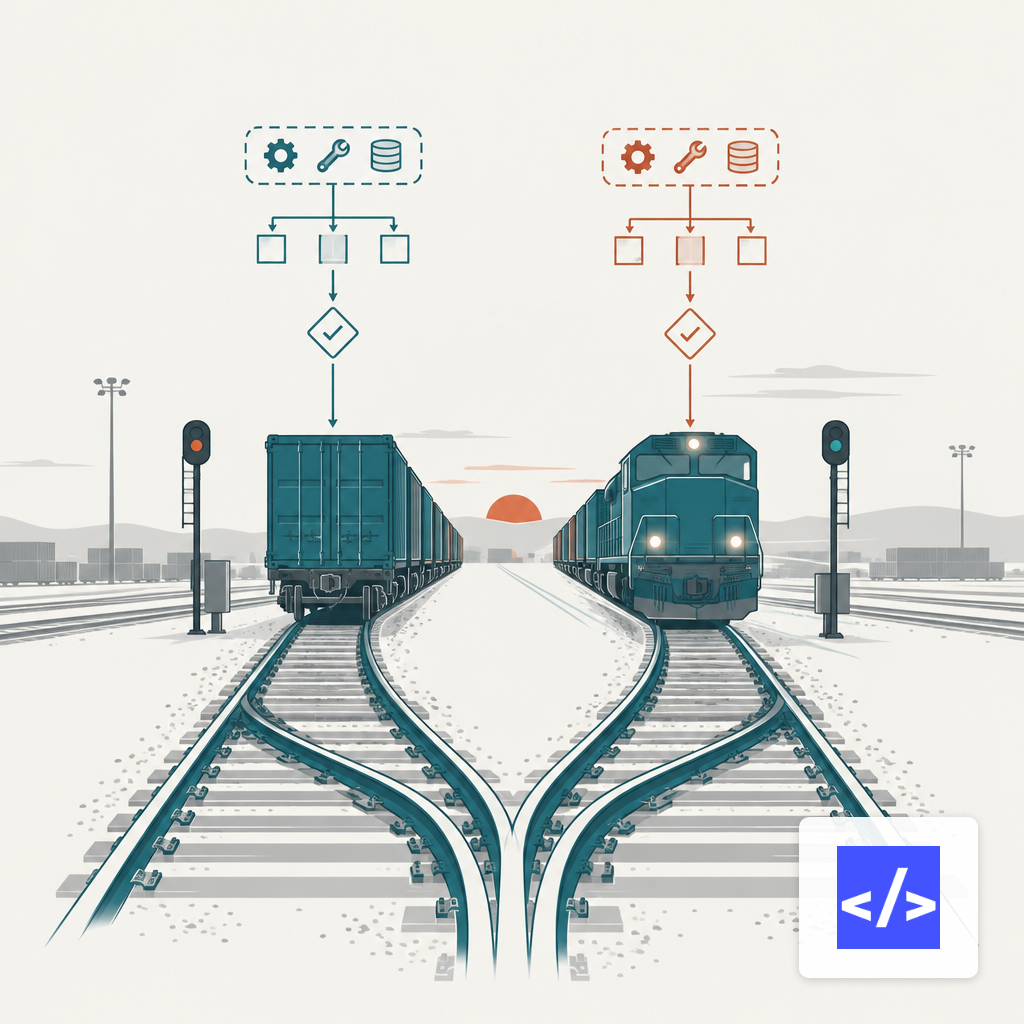
Run in Parallel Until the Agent Has Earned the Keys
Every bot that moves to an agent runs in shadow mode first: the agent executes on real inputs, writes its proposed actions to a log, and the RPA bot continues to perform the live action. Compare outputs daily. When agreement crosses a threshold the business team sets (not the vendor), the agent moves to a tiered approval model, then to full autonomy for low-risk action classes. Our writeup of which agent actions actually need human approval is the practical reference for drawing those tiers.
Two mechanisms do most of the work in a parallel run. First, approval gates on any irreversible action: wire transfers, customer-facing emails, record deletions. Second, idempotency on every tool call so a retry does not double-post. A chatbot's worst failure is a wrong sentence; an agent's worst failure is a wrong wire transfer, and the parallel-run period exists to find that failure before it is live.
Instrument everything the agent does. Lineage from input to tool call to downstream record is not optional in a regulated environment. The failure modes we catalogued in the first 90 days of an agent deployment are almost all observability failures dressed up as reasoning failures.
- 11. Shadow modeAgent logs proposed actions; RPA bot executes live · Daily output agreement crosses business-set threshold
- 22. Tiered approvalAgent executes low-risk actions; humans approve the rest · Approval override rate falls below defined ceiling
- 33. Scoped autonomyAgent acts alone within a bounded action class · Clean incident window across a full cycle
- 44. Full handoverRPA bot retired; agent owns the workflow end-to-end · Lineage, replay, and approval surface signed off
- 55. Steady-state oversightSampling, drift checks, and periodic re-review · Ongoing: review cadence and rollback plan in place
Know Which Bots Should Stay RPA
A sober migration keeps a meaningful share of the estate on RPA for the full planning horizon. The bots that stay share three traits: inputs are structured, the target system has no reasonable API, and the exception rate is already low. Terminal emulators to a mainframe, SAP GUI steps where the BAPI is locked down, Citrix-published applications with no automation hooks. An agent in these places pays computer-use costs for an outcome a selector-based bot already produces reliably.
The governance risk of over-migrating is real. Forrester has warned that if RPA bots are replaced by AI agents without governance, enterprises will face an unmanageable number of overlapping AI agents with poor governance and high run and maintenance costs, repeating the mistakes of the original RPA wave. The failure mode is predictable: every team spins up its own agent, each with its own tool access, no shared registry, no lineage, and within eighteen months the agent estate is more expensive and less observable than the UiPath estate it replaced.
Decide What Replaces the Orchestration Layer
Orchestrator is doing more work than most buyers credit it for: scheduling, credential vaulting, run history, queue management, and the audit trail compliance expects to see. Any replacement plan has to account for all of it. The choice is not simply which agent framework to pick; it is what sits in the place Orchestrator used to occupy.
Three patterns are viable. Keep Orchestrator for the remaining RPA bots and introduce a separate agent control plane alongside it. Replace both with a unified orchestrator that handles agents, scheduled jobs, and human approvals in one place. Or wrap the agent runtime in your existing workflow engine, such as Airflow, if the shop already runs one. Our comparison of LangGraph, CrewAI, and AutoGen for enterprise builds covers the runtime trade-offs; the architectural decision above it is the one that governs cost and audit posture for years.
Whichever pattern you pick, the non-negotiables are the same: a tool registry with scoped credentials, versioned agent definitions, deterministic replay from event logs, and an approval surface the business owner can actually operate. These are the controls a feasibility assessment should produce before any code is written.
What a Realistic Twelve-Month Plan Looks Like
The pattern that holds up across regulated enterprises is boring on purpose. Months one and two: inventory, scoring, and the licensing-cliff model. Months three and four: wave-one pilot on two to four exception-heavy bots, parallel run from day one. Months five and six: cutover of wave one, which also funds the next wave by freeing license spend at the next true-up. Months seven through ten: wave two, the multi-system orchestration bots, with the orchestration layer decision locked. Months eleven and twelve: retire what the inventory said should retire, re-platform what should stay, and renegotiate the UiPath contract with a smaller, more honest footprint.
The failure case to avoid is the one Forrester named: 75% of firms that build aspirational agentic AI architectures on their own will fail, and implementation challenges will stall 25% of agentic AI efforts. The migrations that succeed are the ones treated as a portfolio exercise with real financial modeling, not a technology refresh. The sequencing, the parallel-run discipline, and the honesty about which bots should stay RPA are what separate a program that retires an incumbent from a program that merely adds a second one.
If the next step is an architecture conversation rather than another article, that is the right next step. The questions worth answering first are specific: which three bots in your estate carry disproportionate maintenance cost, what the parallel-run exit criteria look like for each, and what the control plane around the surviving RPA bots and the new agents looks like on one diagram.
Throughout his extensive 15+ year journey as a digital marketer, Sam has left an indelible mark on both small businesses and Fortune 500 enterprises alike. His portfolio boasts collaborations with esteemed entities such as NASDAQ OMX, eBay, Duncan Hines, Drew Barrymore, Price Benowitz LLP, a prominent law firm based in Washington, DC, and the esteemed human rights organization Amnesty International. In his role as a technical SEO and digital marketing strategist, Sam takes the helm of all paid and organic operations teams, steering client SEO services, link building initiatives, and white label digital marketing partnerships to unparalleled success. An esteemed thought leader in the industry, Sam is a recurring speaker at the esteemed Search Marketing Expo conference series and has graced the TEDx stage with his insights. Today, he channels his expertise into direct collaboration with high-end clients spanning diverse verticals, where he meticulously crafts strategies to optimize on and off-site SEO ROI through the seamless integration of content marketing and link building.


Put an agent to work, the right way.
Start on Automatic and put the workflow you want to automate in front of engineers who have shipped agents in regulated environments.
Agentic AI, in your inbox.
Occasional, high-signal notes on building and operating AI agents — automation patterns, architecture, and governance. No spam.