Finance is the First Thing You Should Automate, Here's Why
Finance workflows have the structure, audit trails, and measurable ROI that make them the safest, highest-return place to deploy enterprise AI agents first.

Most agentic AI pilots in the enterprise start where the demo looks best: a customer-service copilot, a sales research agent, a marketing drafting tool. These are reasonable places to learn, but they are poor places to prove the thesis. Their outputs are hard to measure, their failures are hard to price, and their controls do not map to anything the audit committee already recognizes. Finance is the opposite on every axis.
The case for sequencing finance first is not that it is glamorous. It is that finance combines structured data, deterministic outcomes, dollar-denominated ROI, and a control environment built decades ago for exactly the kind of oversight an autonomous agent requires. Approval gates, segregation of duties, idempotency, and lineage are not AI concepts bolted onto finance. They are finance concepts the AI inherits.
So where should the first production agent live, and why does the math keep pointing to the same answer?
The Data Finance Hands You Is Already Agent-Ready
Agents fail on ambiguity. They succeed on structure. Finance workflows run on invoices, purchase orders, GL codes, bank statements, and ERP master data — artifacts with schemas, identifiers, and reconciliation keys. An AP invoice has a vendor ID, an amount, a currency, and a PO reference. A journal entry has a debit, a credit, and a period. The grammar is fixed.
Contrast that with the ambiguity in a sales or support workflow, where the inputs are free text, intent is inferred, and ground truth is contested. For an AP agent, "did the two-way match succeed" has a yes or no answer. The process quality the agent inherits is already high because finance teams have spent decades cleaning up the data path to satisfy auditors.
The volume is also real. Nearly half of finance departments still rely entirely on manual processes, and manual tasks consume roughly 59% of financial resources. That is a large pool of structured, repetitive work sitting behind people who are overqualified to do it.
SOX Already Requires the Controls Agents Need
Every argument for governing an autonomous agent — who authorized this action, what data did it read, what did it change, can it be replayed, who can override it — is already a SOX requirement for the humans doing the same work. Section 404 requires companies to document and test internal controls over financial reporting annually, which is where access controls, segregation of duties, and audit trails live. The compliance surface is not new. The actor is.
This matters because the hardest part of putting an agent into production in a regulated enterprise is usually not the model. It is the evidence package the auditor will ask for: who approved the control design, how exceptions are logged, how segregation of duties is enforced when a non-human can act. In finance, that evidence package already exists for the manual process. The agent inherits the control framework rather than inventing one.
Concretely, three agent primitives line up one-to-one with controls finance teams already run:
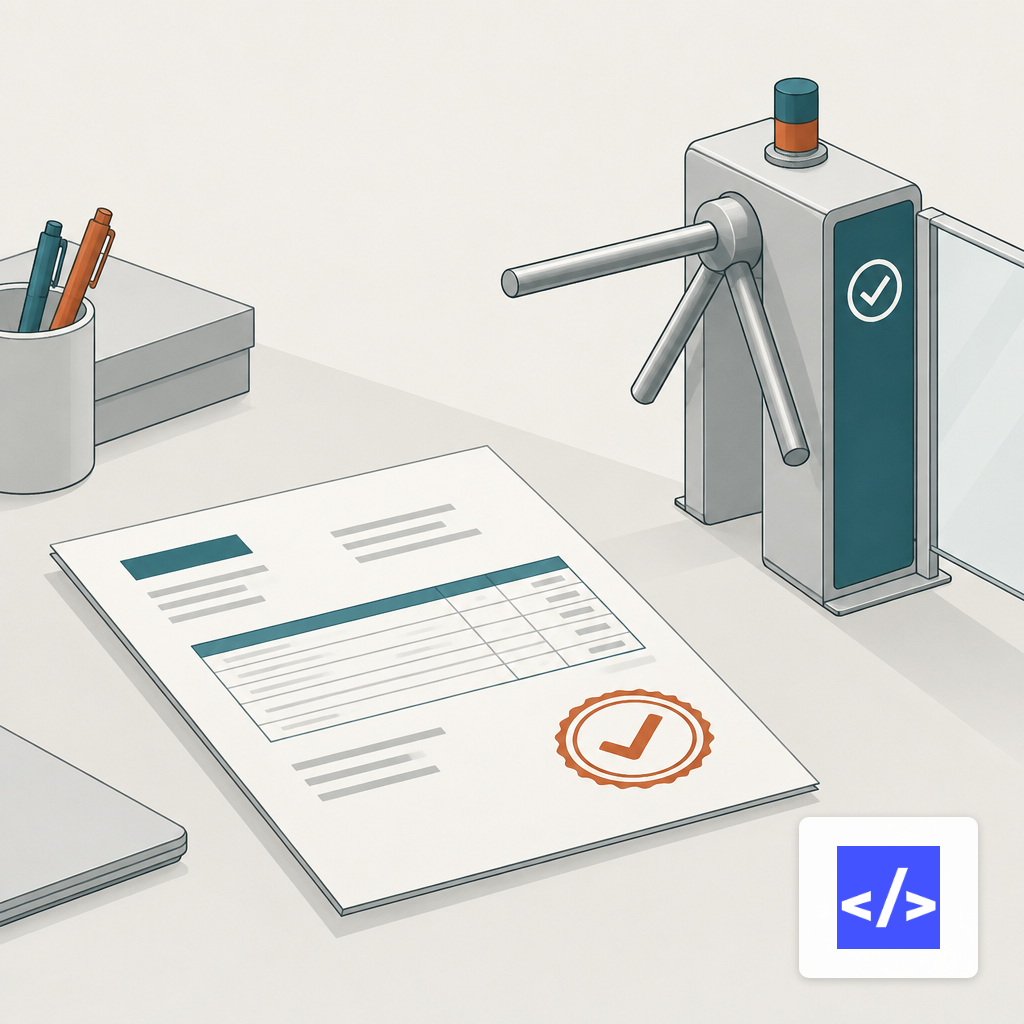
- Approval gates map to delegation-of-authority matrices. Dollar thresholds, dual approvals, and segregation rules are already codified in the DOA. An agent executing within those limits is a tighter control than a human who sometimes rubber-stamps.
- Idempotency maps to duplicate-payment controls. Finance has always cared whether an invoice can be paid twice. The agent's idempotency key is the formalization of a control the team already runs by hand.
- Lineage maps to the audit trail SOX already demands. Every read, write, and tool call the agent makes is the evidence an auditor would otherwise reconstruct from screenshots and emails.
For a buyer evaluating approval gates for finance agents, the question is not whether to build them. It is which existing control they encode.
The ROI Is Denominated in Dollars, Not Vibes
A copilot that helps a seller write faster emails has value, but defending the number in a budget review is an exercise in rhetoric. Finance workflows have unit economics the CFO already tracks.
Invoice processing is the clearest example. The average cost to process an invoice is $9.40, while best-in-class AP teams do it for $2.78, according to Ardent Partners' 2025 benchmark. The spread is not driven by smarter staff. It tracks almost entirely to how much of the workflow a human touches. Multiply that delta against monthly invoice volume and the business case writes itself in a format procurement understands.
Close speed carries the same clarity. APQC benchmarking of roughly 2,300 organizations puts the median monthly close at 6.4 days, with top-quartile teams at 4.8 days or fewer and the bottom quartile at 10 days or more. Automation correlates directly: Ventana Research found that companies with substantial automation close in six days or fewer 88% of the time, compared with only 40% for companies with little or no automation. Those are not vendor claims. They are the numbers the audit committee already reviews.
The honest framing: finance agents do not usually eliminate headcount in year one. They absorb volume growth without adding it, compress cycle times that free up working capital, and move analysts up the stack to exception review and controls work. That is a payback story that fits inside a single fiscal year for most AP and reconciliation deployments, which is rare in enterprise software.
Fraud and Error Make the Downside Case
Automation in finance is not only a productivity argument. The downside of leaving these workflows manual is quantifiable and getting worse. The 2025 AFP Payments Fraud and Control Survey found that 79% of organizations were targets of payments fraud in 2024, with business email compromise cited as the top avenue by 63% of respondents and vendor imposter fraud rising to 45% from 34% the previous year.
These attacks succeed because they exploit the handoffs between humans — a change-of-bank-details email, a last-minute wire request, a vendor onboarding step done over the phone. An agent with a deterministic vendor master, a required out-of-band verification step, and a logged approval gate removes the ambiguity those attacks depend on. The failure mode of a well-governed finance agent is a blocked payment, which is recoverable. The failure mode of the status quo is a wire to an attacker, which is not.
Where the First Agent Should Actually Live
Not all of finance is equally ready. The right first workflow has four properties: high volume of structured input, a deterministic success criterion, an existing control the agent can inherit, and a clear owner who will defend the deployment. Three fit cleanly:
- Accounts payable. Invoice capture, PO matching, GL coding, duplicate detection, and approval routing. Highest volume, clearest unit cost, strongest fraud case.
- Bank and account reconciliations. Structured inputs on both sides, deterministic match rules, and a long tail of exceptions that benefit from an agent proposing dispositions a human confirms.
- Intercompany settlements. Painful at the month-end close, rule-driven, and almost always under-automated because no single ERP owns both sides.
Expense management and the close itself are reasonable second-wave candidates. Treasury, FP&A narrative generation, and tax provision are not beachheads: the data is messier, the outcomes are judgment calls, and the ROI is harder to defend in year one.
The architecture question matters as much as the workflow choice. Finance data rarely leaves the enterprise boundary, which is why most serious deployments run in a VPC or air-gapped posture rather than a vendor SaaS. The agent architecture needs to call ERP, banking, and procurement APIs with the same identity hygiene a human user would, log every tool call to the same SIEM the rest of the finance stack feeds, and expose a replay interface the controls team can actually use.
The Gap Between Intent and Deployment Is the Opportunity
CFOs know this. L.E.K. Consulting's 2025 Office of the CFO Survey found that roughly 60% of CFOs believe AI will be one of the most impactful technologies in the office of the CFO, yet only about 11% use it in their finance functions today, with around 35% beginning to experiment with pilots. The intent-to-deployment gap is the single largest in enterprise software right now, and it is largest in the function with the clearest controls to govern it.
The gap is not a model problem. The models are adequate. The gap is a question of who will stand behind the first production agent that moves money, which controls it will inherit, and how its behavior will be evidenced to an auditor who has never approved a non-human actor before. Those are solvable problems, and they are solvable fastest in a function that has been answering versions of them for twenty years.
Finance is not the easiest place to put an agent. It is the place where the agent's correctness is most measurable, its failures most priceable, and its controls most defensible. For an enterprise sequencing agentic AI from pilot to production, those three properties are what distinguish a reference deployment from a stalled proof of concept. Start where the ledger can tell you whether it worked.
Eric Lamanna is a Digital Sales Manager with a strong passion for software and website development, AI, automation, and cybersecurity. With a background in multimedia design and years of hands-on experience in tech-driven sales, Eric thrives at the intersection of innovation and strategy—helping businesses grow through smart, scalable solutions. He specializes in streamlining workflows, improving digital security, and guiding clients through the fast-changing landscape of technology. Known for building strong, lasting relationships, Eric is committed to delivering results that make a meaningful difference. He holds a degree in multimedia design from Olympic College and lives in Denver, Colorado, with his wife and children.


Put an agent to work, the right way.
Start on Automatic and put the workflow you want to automate in front of engineers who have shipped agents in regulated environments.
Agentic AI, in your inbox.
Occasional, high-signal notes on building and operating AI agents — automation patterns, architecture, and governance. No spam.