Command Line vs Token-Based Cost Control for Enterprise AI Agents
Compare command line and token-based resource optimization for enterprise AI agents, and learn where each cuts cost without starving the workflow.

Most cost debates about agentic AI collapse into a single-metric fight over tokens. That framing is wrong. Token spend is one lever, and it is not even the biggest one in production. The other lever is where the work happens: inside the model's context window, or outside it on a shell, in a script, in a batch job the agent invokes and waits on. The two levers behave differently, fail differently, and apply to different workflow classes. Picking the wrong one is how teams end up with a $40,000 monthly inference bill for a workflow a cron job could have run.
This piece gives a decision framework for which lever applies to which workflow, with the numbers behind each. The short version: token-level accounting controls what the model does with each turn; command-line orchestration controls how many turns the model needs in the first place. One optimizes the engine. The other decides whether you need the engine running at all.
The Two Levers, Defined
Token-based cost control is accounting at the API boundary. It covers model routing (cheap model for triage, premium for judgment), context trimming (truncate transcripts, summarize history, drop tool schemas the agent will not call), and prompt caching. The ceiling here is set by provider pricing. Anthropic's own page states that Claude Sonnet runs at $2 per million input tokens and $10 per million output tokens, with up to 90% savings when prompt caching is engaged. OpenAI's automatic prompt caching applies a 50% discount on prompts longer than 1,024 tokens with no code changes required. These are real but bounded discounts on an activity you have already decided to perform.
Command-line orchestration is a different question entirely. It asks whether the agent should reason its way through a task or shell out to a deterministic program that already solves it. A file rename does not need a language model. Neither does a SQL join, a cron-driven data pull, or a Terraform apply. When the agent calls jq, psql, git, or a vetted internal CLI, the LLM's job shrinks to picking the right command and reading the exit code. The compute cost of the actual work drops to shell time, which is effectively free compared to inference.
The lever matters because they stack. Token controls reduce the cost per turn. Shell orchestration reduces the number of turns. The second lever has a bigger multiplier.
Where Token Controls Save Real Money
Token-level work pays off when the agent genuinely needs to reason, and when that reasoning reuses stable context. Three mechanisms carry most of the savings.
Prompt caching for stable prefixes. System prompts, tool registries, policy documents, and few-shot examples do not change between turns. Caching them turns a recurring input cost into a one-time write. Anthropic's engineering team reports that their multi-agent research system uses roughly 15x more tokens than a standard chat interaction and that token usage alone explains about 80% of performance variance on their internal research evaluation. That is a workload where caching the orchestration prompt is not optional; it is the only way the economics work.
Model routing by task class. Haiku handles classification. Sonnet handles tool selection and most reasoning. Opus handles the hard judgment calls that justify the premium. A gateway that routes by task type, not by developer preference, usually cuts spend 40 to 60% with no visible quality loss.
Context trimming. Agents accumulate transcript. By turn twenty, a naive loop is paying to re-process the first nineteen turns on every call. Rolling summaries, tool-call elision, and hard caps on retrieved document chunks keep the per-turn cost from drifting upward.
None of this changes what the agent is doing. It changes what you pay per turn. If the workflow genuinely requires an LLM on each step, these controls are the whole game. If it does not, you are optimizing the wrong layer.
Where Command-Line Orchestration Wins
The command line is the escape hatch from token economics. When a workflow has a deterministic middle, the agent's job is to decide what to run and to interpret the output. The work itself happens outside the model. This is the pattern behind the current generation of coding agents, and the numbers are instructive. GitHub launched Copilot CLI in public preview on September 25, 2025, with native MCP server integration. Two weeks later, GitHub reported that prompt optimizations delivered a 15% reduction in steps to task completion, a 17% reduction in input tokens, and a 15% reduction in output tokens on Terminal-Bench, cutting average wall-clock time per task by 25%.
Read that carefully. The token savings came from reducing steps, not from a cheaper model. The lever was orchestration, not accounting.
For enterprise workflows, this maps cleanly onto a few patterns we see repeatedly in production action execution:
- Batch jobs invoked by the agent. The agent assembles parameters, kicks off an Airflow DAG or a Spark job, and polls for completion. One LLM call to start, one to interpret the result.
- Deterministic data transforms. jq, awk, duckdb, and a well-formed SQL template beat a model asked to transform JSON turn by turn, both in cost and in correctness.
- Idempotent write operations. A CLI that wraps the actual mutation (with retries, dry-run flag, and a reversal path) means the agent decides once and the shell handles the rest.
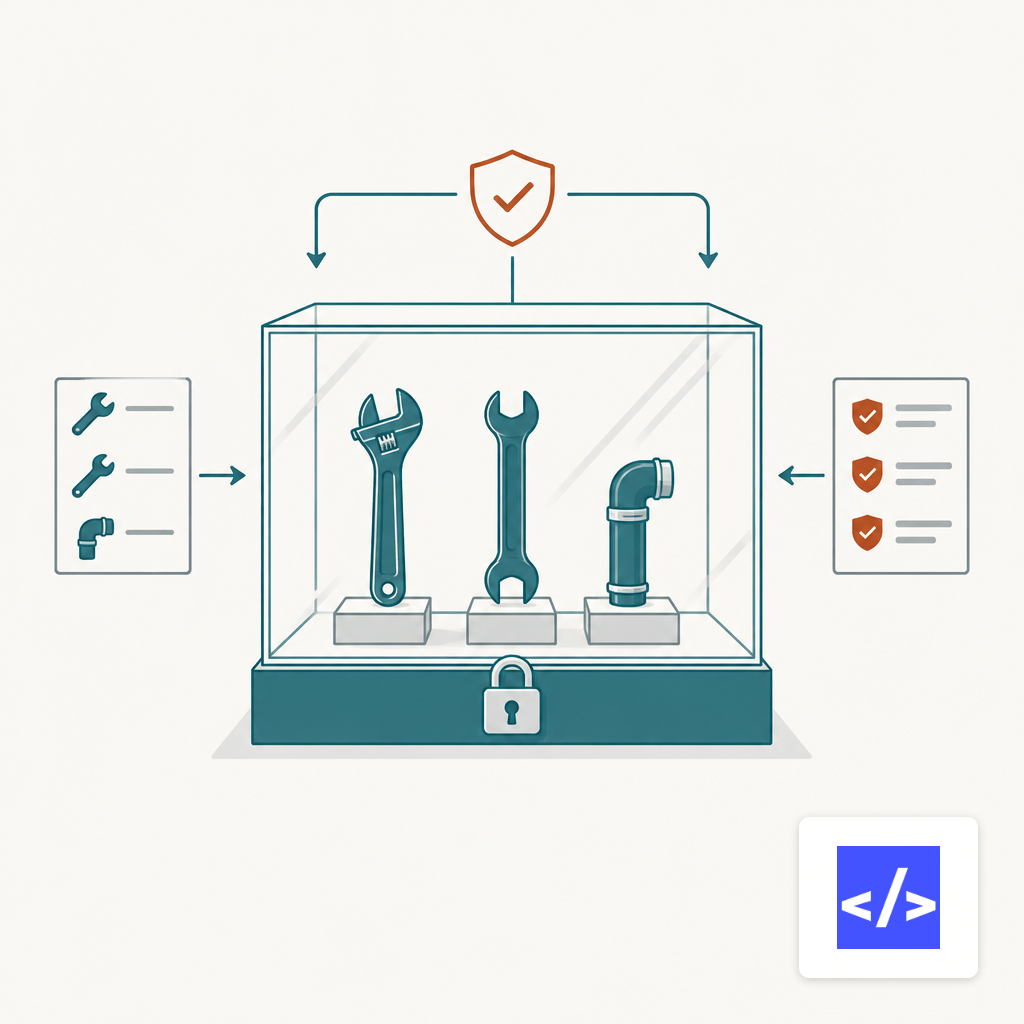
The failure mode is specific. Shell-level orchestration pushes risk out of the model and into the toolchain. An agent that can invoke arbitrary commands is an agent that can invoke destructive commands. The guardrail is a narrow, versioned tool registry, not a general shell, and this is where approval gates and audit trails earn their keep. The Stacklok survey of 300 senior technology leaders in December 2025 found 41% running MCP servers in limited or broad production and 64% naming security as the top obstacle to adoption. The shell-out pattern works. It also multiplies blast radius if the registry is sloppy.
A Decision Framework by Workflow Class
The right lever depends on where the work actually lives. Four workflow classes cover most enterprise cases.
High-reasoning, low-action workflows (research summarization, contract review, incident analysis) are where token controls dominate. The agent is doing the work. Cache the prefix, route to the right tier, trim the transcript. Expect caching alone to carry most of the savings.
High-action, low-reasoning workflows (ERP postings, ticket routing, data pipeline runs) are where command-line orchestration dominates. The agent is a dispatcher. Push every repeated operation into a vetted CLI or batch job. The LLM should pick commands and read exit codes, not transform data turn by turn. Our notes on automating ERP processes walk through this pattern end to end.
Mixed workflows (finance close, procurement, multi-step underwriting) need both. A typical shape: the agent reasons about which records to touch (token lever), then dispatches a deterministic script that touches them (CLI lever), then reasons about the exceptions the script surfaces (token lever again).
Research-heavy workflows that genuinely need parallel sub-agents are the exception that proves the rule. Anthropic's orchestrator-worker system outperformed single-agent Claude Opus 4 by 90.2% on internal research evaluations, at roughly 15x the token cost. The math works for research. It does not work for routine operations, and treating it as a general template is how pilots stall at the ROI review.
Where Each Lever Quietly Fails
Token controls fail silently when caching assumptions drift. A tool registry that changes on every deployment invalidates the cache prefix. A system prompt edited by a well-meaning engineer resets the hit rate to zero. Nothing breaks; the bill just drifts up 3x and nobody notices for a month. The fix is treating prompt and tool definitions as versioned artifacts, which is also the argument for formal agent versioning.
Command-line orchestration fails when the tool registry becomes a general shell. The moment an agent can pipe arbitrary commands, your security review becomes a security incident waiting to happen. The pattern that holds up is a narrow registry of idempotent, auditable commands with explicit approval tiers for anything that mutates state. A chatbot's worst failure is a wrong sentence. An agent with shell access and no registry has a worse one.
Both levers also fail when teams measure the wrong thing. A METR randomized controlled trial of experienced open-source developers found participants took 19% longer to complete tasks while believing they were 20% faster when using AI tools. If engineers cannot assess their own throughput inside a controlled study, your agent dashboard probably cannot either. Measure finished work, not activity.
What To Do Monday
Audit the top five agent workflows by monthly spend. For each, answer two questions. First, what fraction of turns involve genuine reasoning versus deterministic transformation? Second, what fraction of input tokens are stable prefix versus turn-specific context? The first ratio tells you how much orchestration slack you have. The second tells you how much caching slack you have. Workflows above 70% deterministic middle are command-line problems masquerading as model problems. Workflows above 60% stable prefix are caching problems that have been left on the table. Our writeup on which agents actually reduce operating costs covers the audit pattern in more detail.
Token-based cost control and shell-level orchestration are not rival philosophies. They are two levers with different mechanics, and the discipline is knowing which one applies before you pull it. Treat tokens as the price of thinking and the command line as the price of doing, and the agent cost governance conversation stops being a line-item fight and starts being an architecture one.
Throughout his extensive 15+ year journey as a digital marketer, Sam has left an indelible mark on both small businesses and Fortune 500 enterprises alike. His portfolio boasts collaborations with esteemed entities such as NASDAQ OMX, eBay, Duncan Hines, Drew Barrymore, Price Benowitz LLP, a prominent law firm based in Washington, DC, and the esteemed human rights organization Amnesty International. In his role as a technical SEO and digital marketing strategist, Sam takes the helm of all paid and organic operations teams, steering client SEO services, link building initiatives, and white label digital marketing partnerships to unparalleled success. An esteemed thought leader in the industry, Sam is a recurring speaker at the esteemed Search Marketing Expo conference series and has graced the TEDx stage with his insights. Today, he channels his expertise into direct collaboration with high-end clients spanning diverse verticals, where he meticulously crafts strategies to optimize on and off-site SEO ROI through the seamless integration of content marketing and link building.


Put an agent to work, the right way.
Start on Automatic and put the workflow you want to automate in front of engineers who have shipped agents in regulated environments.
Agentic AI, in your inbox.
Occasional, high-signal notes on building and operating AI agents — automation patterns, architecture, and governance. No spam.