Agentic AI ROI Statistics vs Traditional Automation Profitability
Verified 2025 and 2026 ROI data comparing agentic AI, RPA, rule-based automation, and human labor across cost, payback, error rates, and scalability.

The question has moved past whether agentic AI works. It is now whether the TCO curve justifies replacing a working RPA bot, a stable rule engine, or a human analyst. The answer is not uniform. It depends on the workflow, the exception rate, the governance load, and the honesty of the baseline you compare against.
This piece assembles a defensible 2025 and 2026 statistical reference for that decision. It compares autonomous agents against robotic process automation, rule-based automation, and human labor across implementation cost, error profile, payback period, and long-run profitability, and it names the workflows where traditional automation or people remain the cheaper answer.
The Baseline Nobody Wants to Audit
Before any agent discussion is useful, the alternative has to be priced correctly. RPA has carried a reputation for cheap, fast returns that the operating data no longer supports. An EY study on robotic automation put the failure rate on initial RPA projects at 30% to 50%, and a Deloitte survey of 400 enterprises found 63% experienced delays and missed deadlines on their deployments.
The license fee is the smaller part of the problem. Industry TCO analysis estimates that for every $1 spent on RPA licensing, enterprises spend an additional $3.41 to $4.00 on consulting, infrastructure, and ongoing maintenance. That 1:4 ratio is structural: screen-scraping bots fail when a button moves, so UI drift becomes a permanent repair bill. Rule-based automation looks cleaner on paper, but it carries the same tax in a different form: the rule set grows faster than the business logic, and every edge case becomes a ticket.
Human labor is the honest third baseline. For a customer service ticket, Fin AI's 2026 benchmark puts fully loaded cost at $6.00 to $13.50 per resolved contact. For a finance analyst reconciling exceptions, it is higher once error rates and rework are included. Both numbers deserve a line in the ROI model, not a footnote.
What Agentic AI Actually Costs in 2026
Agent economics split along deployment model. SaaS agents price per seat, per task, or per resolution. Private deployments inside a VPC or on-prem carry higher fixed infrastructure and inference cost but lower marginal cost at volume. A regulated enterprise picking between them is really picking between opex predictability and data-boundary control, and the deployment model comparison has implications well past price.
On a like-for-like coverage basis, independent 2026 comparisons from Beam AI's RPA-versus-agent analysis put year-one spend at roughly $228,000 for an RPA deployment versus $77,000 for an equivalent AI agent platform, a 66% delta. Annual maintenance runs 20% to 30% of initial build for RPA versus 10% to 15% for agents, so the two curves diverge every year the system is in production. Those are vendor-adjacent figures and should be read as directional rather than audited, but the direction is consistent across sources.
The costs an agent business case tends to under-count are inference, evaluation, and human oversight. Inference is a per-run variable cost that RPA does not carry. Evaluation is a continuous engineering line, not a one-time QA pass. Human-in-the-loop review is a labor line that scales with risk tier, not volume, and treating it as free is the single most common reason pilot ROI does not survive production.
| Dimension | Rule/RPA | AI Agents | Human Labor |
|---|---|---|---|
| Year-1 build cost (equiv. scope) | ~$228K | ~$77K | N/A |
| License-to-TCO multiplier | 1:4 | 1:1.5–2 | N/A |
| Annual maintenance (% of build) | 20–30% | 10–15% | N/A |
| Cost per customer ticket | $1–$3 | $0.50–$2.00 | $6.00–$13.50 |
| Handles unstructured input | No | Yes | Yes |
| Fails on UI/format change | Yes, hard stop | Degrades gracefully | Adapts |
Payback Periods by Workflow, Not by Vendor
Headline payback numbers are useful only when disaggregated. The 2026 median across BCG and Forrester survey data lands at 5.1 months for AI agent deployments overall, but the spread hides the real decision. Customer service agents reach positive ROI around 4.1 months. Finance and operations agents take closer to 8.9 months. Legal and clinical workflows run longer still, because governance review consumes most of the raw speed advantage.
Not every rollout gets there. Gartner's 2026 agentic AI pulse data shows that only 41% of agent rollouts cross positive ROI within 12 months, and 19% never reach payback. The failure mode is almost never model capability. It is evaluation drift, governance gaps, and rework that the business case did not price. Our own breakdown of realistic payback periods by workflow walks through the same math with named line items.
Error Rates, Hallucination, and the Right Comparison
A chatbot's worst failure is a wrong sentence. An agent's worst failure is a wrong wire transfer, a mispriced trade, or a patient record updated against the chart. The comparison that matters is not agent accuracy against a benchmark; it is agent accuracy, with governance overhead, against the baseline process it replaces.
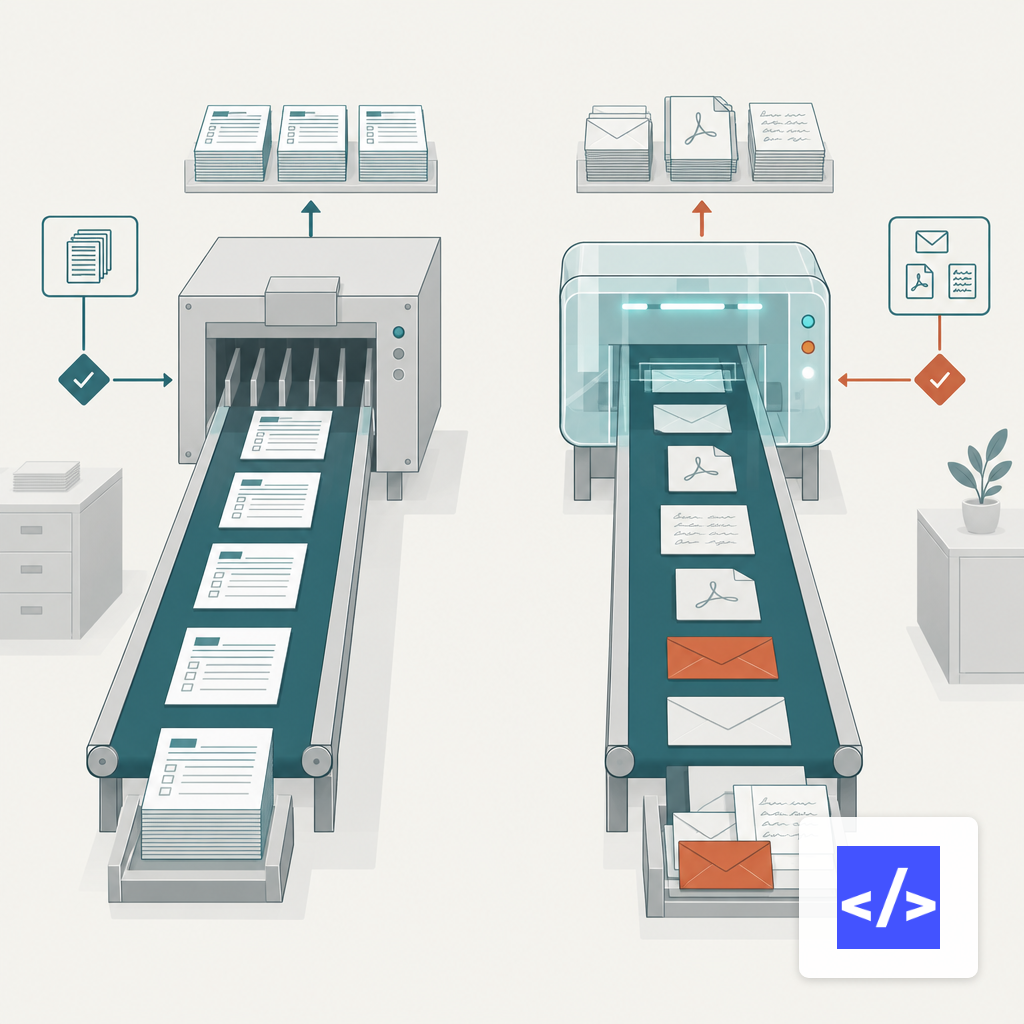
Rule-based automation has an error rate near zero inside its defined scope and near 100% outside it. RPA inherits the same profile and adds brittleness: when the UI changes, the bot does not degrade, it stops. Human processing error on repetitive back-office work runs in the low single digits per transaction, higher when fatigue, handoffs, or exception volume rise. Agents sit between those modes. They handle unstructured input that RPA cannot, but they produce probabilistic output that requires an approval gate on any action with material consequence.
The design question is which actions those are. We have argued elsewhere for an explicit tiering of which agent actions actually need human approval, because a flat "human-in-the-loop" policy either drowns reviewers or waves through the risky calls. For high-stakes workflows, the right ROI model counts the reviewer's time against the agent's savings and still clears a hurdle.
Sector Benchmarks Worth Trusting
Reported productivity and payback vary by function in ways that generic ROI claims obscure. The useful 2026 pattern across Bain and digital-applied benchmark data:
- Customer support. Median payback 4.1 months. Cost per resolved ticket drops from the $6 to $13.50 human range to roughly $0.50 to $2.00 for agents, with resolution rates in the 60% to 80% band once knowledge bases are curated.
- Finance and accounting. Payback 6 to 9 months on invoice processing, reconciliations, and controls monitoring. The gain is less about speed and more about catching exceptions earlier, which is why we have argued finance is the first function worth automating.
- Legal and clinical. Productivity multipliers of 1.2x to 1.4x. Governance review eats most of the raw speed advantage, and payback runs 14 to 20 months.
- Back-office operations. Mixed. Stable, structured workflows still favor RPA. Workflows that start with human communication (email, PDF, voice) favor agents.
- Software engineering. Highest per-task savings of any category in 2026 benchmarks, but gains concentrate in code review and generation rather than architecture work.
Why the Headline ROI Numbers Keep Missing
Adoption and value are not the same thing. McKinsey's 2025 State of AI found that 88% of organizations now use AI in at least one business function, but only about 6% qualify as high performers attributing more than 5% of EBIT to AI, and roughly 23% are scaling agents in at least one function. Deloitte's 2025 Emerging Technology Trends survey is sharper: 38% of enterprises are piloting agentic solutions, but only 11% are running them in production, while 42% are still developing a strategy and 35% have none at all.
Gartner's prediction that over 40% of agentic AI projects will be canceled by the end of 2027 reads less as a warning about model quality and more as a prediction about governance. The projects that stall share a profile: automated against a broken process, measured on activity rather than outcome, and shipped without lineage or audit trails that a regulator would accept. We watch the same pattern show up in the first 90 days of agent deployments.
A Workable ROI Formula
Most agent business cases fail the audit at the same two lines: oversight cost and rework. A defensible model for a given workflow looks like this:
- Gross savings = (baseline cost per transaction − agent cost per transaction) × annual volume × automation rate
- Oversight cost = reviewer hourly cost × average review minutes × (volume × review rate)
- Rework cost = downstream correction cost × error rate × volume
- Platform TCO = licenses + inference + integration + evaluation + maintenance (10% to 15% of build annually)
- Net annual value = Gross savings − Oversight − Rework − Platform TCO
- Payback period (months) = (Implementation + Integration) ÷ (Net annual value ÷ 12)
The automation rate and review rate are the two numbers executives most often get wrong. Automation rate at month six is not automation rate at month one. Review rate drops only as evaluation infrastructure matures, which is why automation ROI models that assume steady-state day one tend to overstate payback by three to six months.
When Agents Lose
Agents are not the right answer everywhere. Rule-based automation remains cheaper and safer for stable, structured workflows with low exception rates and no unstructured input. RPA remains defensible when the surrounding systems are stable, the volume is high, and the cost of a UI change is low. Human labor remains cheaper for low-volume judgment work where the fixed cost of agent infrastructure, evaluation, and oversight cannot amortize.
The useful filter is exception rate. If handling exceptions already consumes more human time than the automated path saves, that workflow has crossed the threshold where an agent is cost-competitive. If it has not, more rules will usually beat a new model.
What a Credible Agent Program Looks Like
The pattern among the enterprises actually capturing value is consistent. Narrow first workflow. Explicit approval tiers. Audit trail from day one. Evaluation harness before launch, not after. Separate budgets for inference, oversight, and maintenance. A clear owner for the agent as production software rather than a project.
That is the operating model Automatic.co is built around. We design, build, and run autonomous agents inside clients' own environments, with the guardrails and observability that regulated enterprises require. If you want to pressure-test an agent business case against the benchmarks above, an AI feasibility assessment is a reasonable starting point. The numbers in this piece should hold up in that conversation. The ones that do not should get cut from the model before the budget request goes in.
Throughout his extensive 15+ year journey as a digital marketer, Sam has left an indelible mark on both small businesses and Fortune 500 enterprises alike. His portfolio boasts collaborations with esteemed entities such as NASDAQ OMX, eBay, Duncan Hines, Drew Barrymore, Price Benowitz LLP, a prominent law firm based in Washington, DC, and the esteemed human rights organization Amnesty International. In his role as a technical SEO and digital marketing strategist, Sam takes the helm of all paid and organic operations teams, steering client SEO services, link building initiatives, and white label digital marketing partnerships to unparalleled success. An esteemed thought leader in the industry, Sam is a recurring speaker at the esteemed Search Marketing Expo conference series and has graced the TEDx stage with his insights. Today, he channels his expertise into direct collaboration with high-end clients spanning diverse verticals, where he meticulously crafts strategies to optimize on and off-site SEO ROI through the seamless integration of content marketing and link building.


Put an agent to work, the right way.
Start on Automatic and put the workflow you want to automate in front of engineers who have shipped agents in regulated environments.
Agentic AI, in your inbox.
Occasional, high-signal notes on building and operating AI agents — automation patterns, architecture, and governance. No spam.